X-ray Diffraction Analysis Laboratory
within the Department of Geochemistry of Sedimentary Strata of NGP,
Institute of Geology and Geochemistry of Combustible Minerals, NAS of Ukraine
Founded in 1976
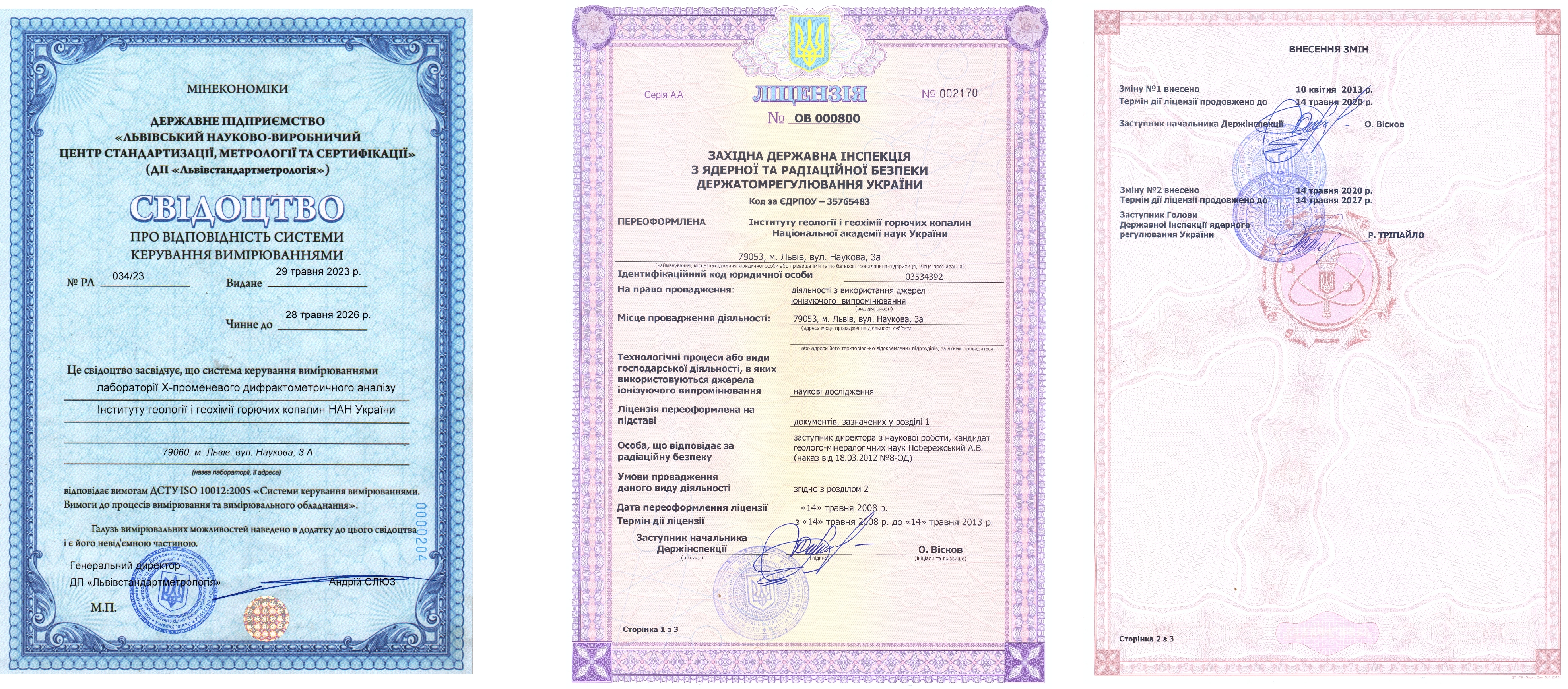
- The X-ray Diffraction Analysis Laboratory complies with the current sanitary rules and regulations OSPU-2005, NRBU-98 and the requirements of DSTU ISO 10012:2005 “Measurement management systems. Requirements for measurement processes and measuring equipment” (Certificate No. RL 034/23 issued on 29 May 2023 by the Lviv Scientific and Production Center for Standardization, Metrology and Certification of the State Enterprise “Lvivstandartmetrology”). The laboratory operates in accordance with legislative acts and regulatory documents governing work with sources of ionizing radiation, as well as the Statute of the Institute of Geology and Geochemistry of Combustible Minerals of the NAS of Ukraine.
X-ray diffraction studies are carried out under
License OV 000800 for activities involving the use of ionizing radiation sources, issued by the Western State Nuclear and Radiation Safety Inspectorate of the State Nuclear Regulatory Inspectorate of Ukraine and valid until 14 May 2027.
- Areas of activity: solving research problems in mineralogy and evaporite-related rock formation, as well as integrated studies aimed at addressing environmental issues.
- Equipment.
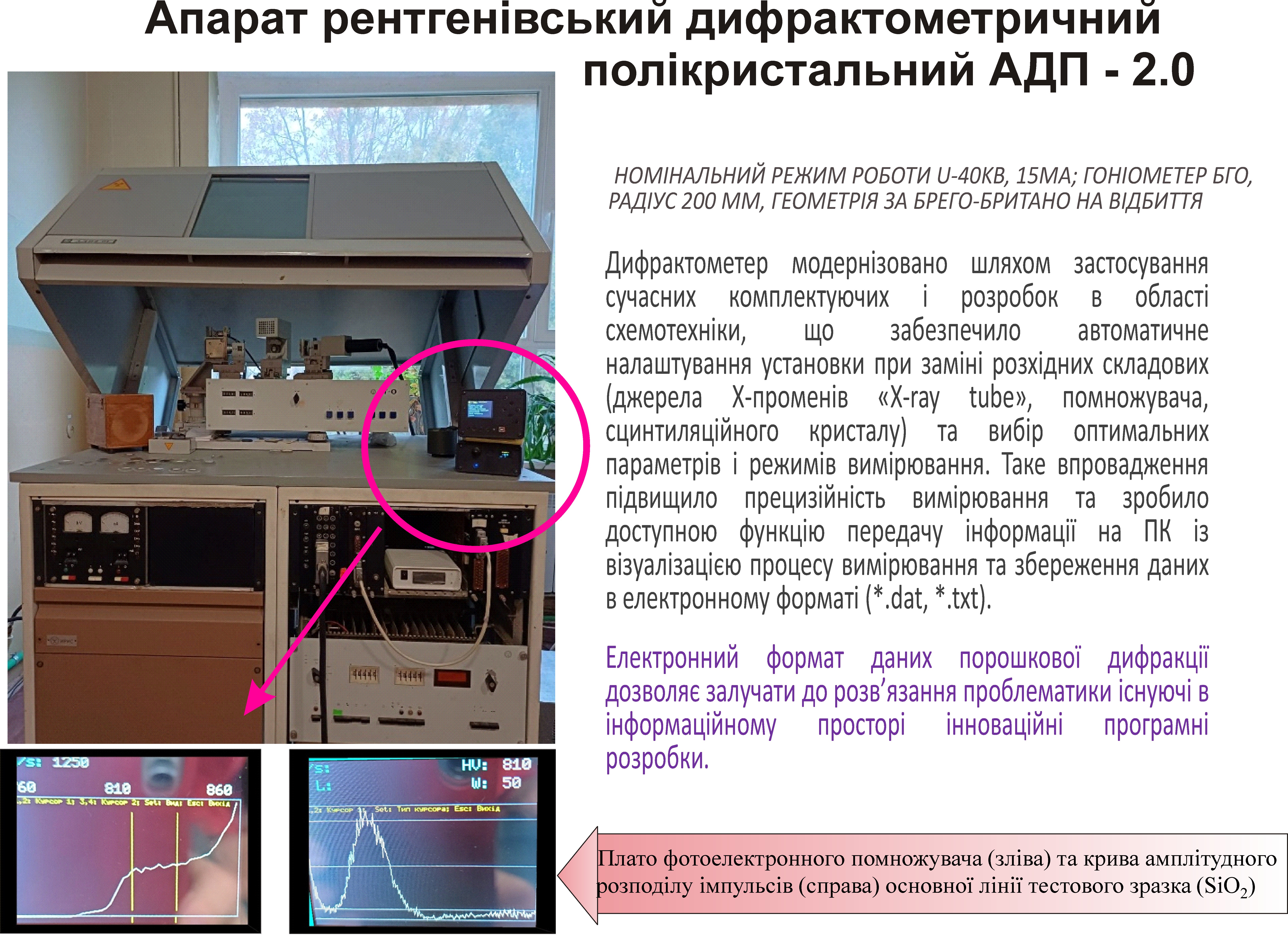
The laboratory operates an installation with ionizing radiation sources: a polycrystalline X-ray diffractometer ADP-2-01 (nominal operating mode U-40 kV, 15 mA; BGO goniometer, radius 200 mm, Bragg–Brentano reflection geometry). The diffractometer has been modernized through the application of modern components and electronic design developments, providing automatic system adjustment when consumable parts are replaced (X-ray tube, photomultiplier, scintillation crystal) and selection of optimal measurement parameters and modes. These upgrades increased measurement precision and enabled data transfer to a PC with visualization of the measurement process and electronic storage (*.dat, *.txt). The digital format of powder diffraction data allows the application of innovative software tools available in the information space for solving research problems.
- Software.
The laboratory uses: the data-processing program Origin 8.6; the automatic phase-search program Crystallographica Search-Match Version 2.0.3 (1996–1999), equipped with the ICDD (International Center for Diffraction Data) electronic database and quantitative analysis by the corundum number method; the Profex Version 4.3 automatic search program, which allows users to independently expand the mineral database using international sources — the American Mineralogist Crystal Structure Database (AMCSD) and the Crystallography Open Database (COD). Quantitative phase analysis in Profex-4.3 is based on Rietveld refinement profile modelling and includes determination of amorphous phases through the introduction of an internal standard; PyXRD-0.7.2 software is used for quantitative identification of clay minerals by modelling one-dimensional X-ray spectra from layered structures.
- Analytical studies: the laboratory performs qualitative and quantitative phase analyses in accordance with the “Scope of Measurement Capabilities” (appendix to Certificate No. RL 034/23 of accreditation) and current regulatory and technical documentation (DSTU, GOST):
-
-
- study of the mineral composition of sedimentary deposits;
• study of the mineral composition of evaporitic halogen deposits and their water-insoluble residue;
• study of the mineral composition of rocks, ores and products of their beneficiation and processing;
• study of the mineral composition of technological waste;
• study of the inorganic fraction of solid fossil fuels (coal, peat);
• study of the phase composition of chemical compounds and inclusions;
• study of the mineral composition of bottom sediments of natural water bodies and technogenic settling ponds;
• determination of the biomineral composition of formations in the human body (uroliths, nephroliths, bilioliths).
Special attention is given to the identification of clay minerals and mixed-layer phases in the pelitic fraction, with refinement of their crystal structures. Investigations are conducted on oriented mounts and are accompanied by additional chemical (acid treatment, saturation with cations, organic liquids) and thermal treatments (heating at various temperatures). Determination of the structural type of clay phases requires recording a fragment of the diffractogram (060 reflection region) of a non-oriented mount of the pelitic fraction. When necessary, additional sample preparation is performed: decarbonation with organic acid solutions (acetic, formic); removal of dispersed organic matter using hydrogen peroxide solution; removal of sulfates with 1 M NaCl solution.
Alongside fundamental and applied research projects, the laboratory conducts contractual studies for external organizations in accordance with Ukrainian legislation to support cooperation in solving industrial and scientific problems. Results are provided to the client in the form of an analytical report; when required, interpretation of the data, accompanying conclusions and recommendations are included.
The cost of analyses is contractual and calculated individually for each request, depending on the time required and consumables.
- Contacts.
Address: Ukraine, 79060, Lviv, Naukova Street, 3a,
Institute of Geology and Geochemistry of Combustible Minerals, NAS of Ukraine
(X-ray Diffraction Analysis Laboratory – XRD)
E-mail: igggk@mail.lviv.ua
Institute reception desk: +38 (032) 263-25-41; fax +38 (032) 263-22-09
Person responsible for the laboratory:
Yaremchuk Yaroslava Vasylivna, PhD in Geological Sciences,
Senior Researcher, Department of Geochemistry of Sedimentary Strata,
of Oil and Gas Provinces, IGGGK NAS of Ukraine
Tel.: +38 (050) 539-39-53, +38 (068) 782-87-57
slava.yaremchuk@gmail.com
Naukova Street, 3a, Lviv 79060, Room 95
 Українська